 Français (France)
  Finnish (FI)
  English (United Kingdom)




Instead of just tracking the project schedule and budget, the Project Success Vector provides a clear and simple way to measure the results of the project through three dimensions: stakeholder satisfaction, achievement of benefits and planning accuracy.
Evaluation of components
Stakeholder satisfaction
This dimension can be measured through satisfaction surveys, and metrics related to customer loyalty and reference value (such as NPS (Net Promoter Score®)). As the Project Success Vector itself, also the surveys should be kept as clear and simple as possible. Here are some sample questions based on the evaluation scale, and thus providng a practical way of evaluating the stakeholder component:
- How satisfied are you with the project as a whole?
- How clear and timely is the project communication?
- How well can you influence the project?
- How well do the project results correspond to the expected benefits?
Also open-ended questions can be used, providing additional information to measured component value.
Achievement of benefits
Measurement is done against the desired project benefits. It is worth noting that added value is only created when the benefits are greater than the investment, or effort (figure 1)

Figure 1. Value creation in PM competence development.
Planning accuracy
Measurement is based on the deviation from planned values. If you want to emphasize a particular perspective (schedule, costs, or scope), planning accuracy can be further divided into these sub-items with their own weights.
Measuring success
The weights
Projects are different: scientific projects might emphasize achievement of results over strict planning accuracy, whereas in delivery projects planning accuracy is an important issue, so we need weights, which reflect the prioritization of components.
We can then think of project success as a weighted resultant vector. The specific formula is presented in 'Governing through success vector' article.
Threshold values
In practice, a certain minimum or threshold value is required for the different components of the Project Success Vector. This way you can avoid situations where a poor performance in one component is masked by strongly performing components.
Reviews
As Project Success Vector is conceptually simple, it can easily be linked to phase review or gate model. Remember to measure the success vector at the following reviews or control gates:
- Initiation
- Major milestones
- Transition to execution
- Transition to operations
- Post-implementation
Get the necessary checklists and templates from the Project Manager's Guide (figure 2).
Figure 2. Project Manager's Guide.
Interpreting the success vector
The length of the resultant vector (through Pythagora's theorem) reflects project's success (figure 3). To express the resultant as success index in terms of a fractional or percentage value we need to scale (normalize) each component relative to its maximum or target value.
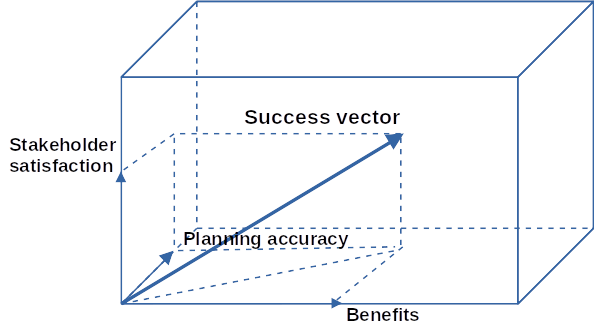
Figure 3. Project success vector.
Success vector has both a length and a direction, so its rotation in the 'success cube' shows how the components of success have changed since the previous review.
Hints and remarks
- One might reasonably argue, that staying below budget and finishing ahead of planned schedule would be even better than accurately reaching them. There is, however, another argument, which emphasizes the importance of planning accuracy itself. If our plans are accurate, we can better control the overall project portfolio.
- Components are often at least somewhat correlated. Calculating the resultant based the formula defined in the 'Governing through success vector' article does not show these correlations. Yet, at the same time formula needs to be conceptually simple.
- Refer to clearly defined and agreed metrics, surveys, templates, checklists and protocols
- Define weights at project approval and document them in the business case or similar document.
👉 Register: AI and tools supporting project success