 Français (France)
  Finnish (FI)
  English (United Kingdom)





Reflecting further based on the earlier post 'From training to success', could success vector be used as project governance tool?
The challenge
If project governance focuses too heavily either on strategic issues such as business benefits or either on operational effectiveness balance might be lost.
Traditional governance models tend to:
- emphasise reporting over reflection
- measure deviations more than impact, and
- reward compliance more than judgement.
As a result:
- a project can be “green” in status reports, yet
- weak in benefits, or
- deteriorating in stakeholder confidence.
Without using too much of mathematical formalism the art of balancing could be supported through a concept of Project Success Vector (figure 1). In vector terms, delivery performance may be strong — but the overall magnitude of success remains modest.
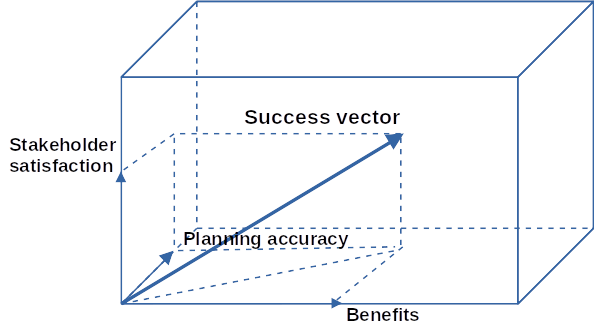
Figure 1. Project success vector.
The components
Looking at the figure 1 we can think of success as a vector composed of three core components (dimensions):
- Stakeholder satisfaction: legitimacy and perceived value
- Achievement of benefits: strategic impact
- Planning accuracy (or delivery performance): execution discipline
Two first ones are more strategic and the third one an operational component.
The length of the resultant vector (through Pythagora's theorem) would then reflect our project's success. To express the resultant in terms of a fractional or percentage value (success index) we need to scale (normalize) each component relative to its maximum or target value.
For the stakeholder satisfaction and the achievement of benefits the target would be total score from surveys or metrics. Scaled planning accuracy would be expressed as unit (1 or 100) minus relative (measured in fractional or percent values) deviation from planned values. Reason for this being that deviation from planned values can go to either direction and we want to remain in 0-100 or unitary scale for each component. If you want to emphasize either schedule, cost or scope accuracy over the other ones you could further divide planning accuracy into separately weighted components.
The weights
Projects are different: scientific projects might emphasize achievement of results over strict planning accuracy, whereas in delivery projects planning accuracy is an important issue, so we need weights, which reflect the prioritization of components.
We can then think of project success as a weighted resultant vector, which can be expressed as the formula [1], where |X| is the length of the normalized success vector, xi are components and wi weights, and n is the number of components (dimensions). This is the only formula in the post.
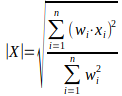 [1]
[1]
Governing the project
Traditionally we could ask:
- “Are you following the method?”, or
- “Have you updated the plan?”
Using success vector we would ask:
- “Are stakeholder relationships strengthening?”,
- “Is the expected value still realistic?”,
- “What trade-offs are you making?”, and
- “Is the project’s direction still aligned with long-term or strategic targets?”
This shifts governance from compliance to guidance. Success vector should be reviewed at main control gates:
- Initiation
- Major milestones
- Transition to execution
- Transition to operations
- Post-implementation
Look at the trends instead of snapshot values.
Closing remarks
- You could define minimum threshold values for the components. This way you can avoid situations where a poor performance in one component is masked by strongly performing components.
- One might reasonably argue, that staying below budget and finishing ahead of planned schedule would be even better than accurately reaching them. There is, however, another argument, which emphasizes the importance of planning accuracy itself. If our plans are accurate, we can better control the overall project portfolio.
- Components are often at least somewhat correlated. Calculating the resultant based on formula [1] does not show these correlations. Yet, at the same time formula needs to be kept conceptually simple.
- Refer to clearly defined and agreed metrics, surveys, templates, checklists and protocols.
- Define weights at project approval and document them in the business case or similar document.
Projects today can be highly complex in a multi-stakeholder and rapidly changing environment. They require high visibility and scrutiny with simple enough governance models. Success vector balances different concerns in a simple, yet powerful way.
When you support governance with meaningful training (see post 'From training to success') your projects will unfold successfully.
👉 Register: AI and tools supporting project success