 Français (France)
  Finnish (FI)
  English (United Kingdom)






Figure 1. Project pain.
Having been a project management trainer during this millennium, more or less, I have wondered why project training rarely produces results. There are certainly no conclusive research results on the subject, so I am careful with phrasing. Training does not automatically translate into lessons, let alone better performance. I have divided the obstacles into three categories.
Factors related to training
Problems caused by training are largely related to the first phases of the chain describing effective learning (Figure 2).
Often, at the beginning of training, the necessary motivation is not created and as a result, the attention of the trainees is not achieved. In the worst case, this leads to the trainees starting to do other work and tasks during the training, practically a waste of time.
Even if attention is generated, there is simply too much to absorb. The prerequisite for memorization is sufficient repetition of things during and after the training, as well as active recall with exercises and questions.
Training may have successfully addressed issues related to memorization, but it mainly focuses on methodologies, concepts, models, tools or certificates. Participants learn what project management or related certificates include, but not necessarily how to apply the concepts in their own work. The gap between education and work also arises from exercises and examples that are too theoretical, resulting in a lack of understanding.
When buying project management training, find out from the training provider:
- Does the provider have a lesson plan, or equivalently how does the training support the acquisition of new knowledge and skills, leading ultimately to more efficient behavior?
- Does the training use a learning diary or similar document that is actively used also after the training?
- What kind of examples are used in the training, or does the training schedule allow the application of learnings in your own projects?
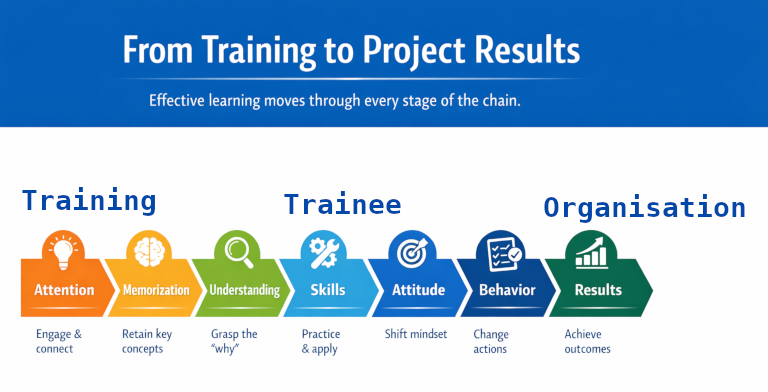
Figure 2. From training to results.
Factors related to the trainee
After training, the ball is passed to the trainee. An athlete cannot reach the Olympics or a musician the top level by just listening to instructions. Practice is required so that the information acquired in the training will result in improved skills. An athlete or musician starts with simple exercises before moving on to more demanding skills or exercises. Similarly, a person studying project management must first master the basics.
Successful project work often requires a change in mindset: moving from realism to optimism, from anticipation to reactivity, and from hiding behind roles to taking responsibility. Attitudes change when the trainee acquires new skills and sees the benefits of professional project management in their own everyday life. Training must also be able to challenge prevailing attitudes.
Changing behavior requires instilling habits and routines through a sufficient number of repetitions.
Before attending training, ask yourself:
- Can I apply the learnings to my own projects and gradually acquire new skills during the training or, alternatively, immediately after it?
- Do I have time to revisit what I learned to ensure sufficient review and acquisition of skills?
- Do I have the required attitude to change behavior and instill habits through consistent long-term practice?
Organisational factors
The organisation must provide the learner with the opportunity to apply what they have learned. Project owners may not understand project management concepts, current processes or mindsets do not allow for adequate management of projects, the project manager’s authority is unclear, or problems may be hidden.
Incentives may favor speed over realism, optimism over accuracy, or comfort over results. In this case, decisions are skipped, schedules are not negotiated, and risks are not discussed.
Before training, check from your own organization:
- Have the benefits of professional project management at different levels of the organization been understood, i.e. does the organisation have a proper project culture?
- Do current processes and mindsets support the application of project management learnings?
- Do project managers have sufficient authority to successfully lead projects?