 Français (France)
  Finnish (FI)
  English (United Kingdom)





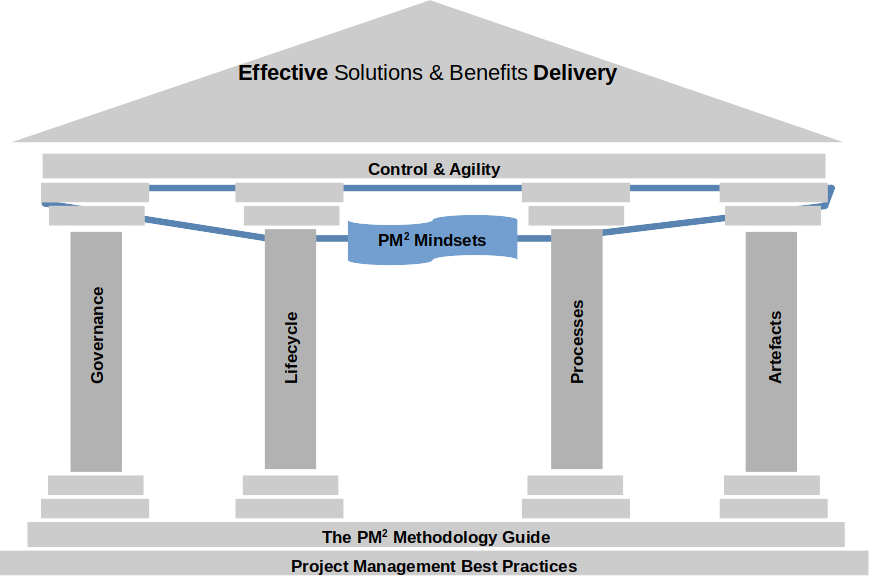
First pillar of the PM² house is the governance model.
What is the PM² Governance Model?
In the PM² methodology, project governance means clearly defined roles, responsibilities, and decision-making processes that support the achievement of project objectives throughout the entire lifecycle. Governance isn't bureaucracy — it's the structure that enables smooth collaboration, timely decisions, and effective use of resources.
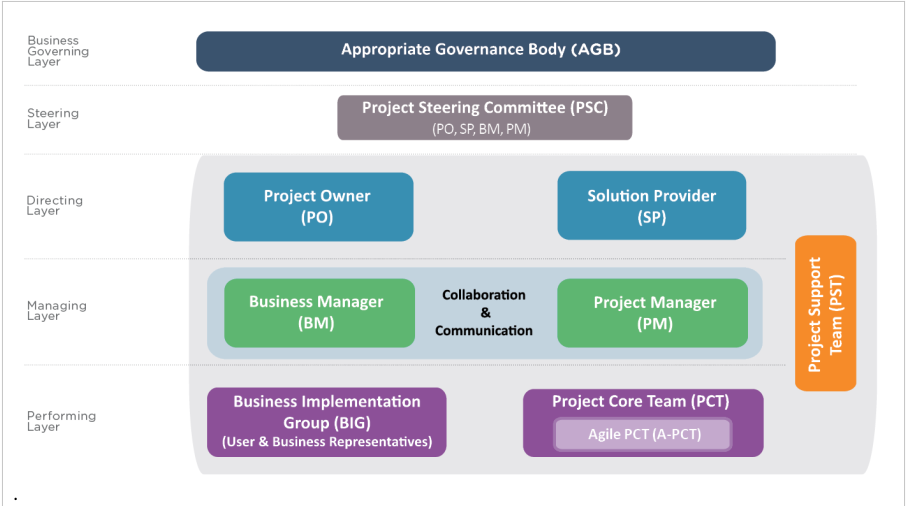
At the heart of the PM² governance model is the concept of a single, unified project team consisting of roles and responsibilities in different layers.
The Five Layers of PM² Governance
PM² organises the project around five distinct layers. Each layer complements the others, forming a coherent and functional governance structure.
1. Business Governing Layer
The organisation's top management, responsible for setting the strategy and prioritising investments. This is where decisions are made about which projects get the green light — and what resources are allocated to them. In public sector contexts, this layer is often represented by a ministry, funding body, or executive board.
2. Steering Layer
The Steering Layer ensures the project stays aligned with its objectives and reports upward to the Appropriate Governance Body (AGB). It comprises roles from both the Directing and Managing Layers, along with other optional advisory roles, and provides overall direction and guidance throughout the project.
3. Directing Layer
This layer champions the project and owns its Business Case. It mobilises the resources needed and monitors performance against objectives. The Directing Layer consists of two key roles: the Project Owner (PO), who represents the beneficiary perspective, and the Solution Provider (SP), who oversees the delivery of project outputs. In EU-funded projects, the PO is typically the grant recipient organisation and the SP the implementing body.
4. Managing Layer
The day-to-day operational layer, responsible for organising, monitoring, and controlling work so that deliverables are produced on time and to standard. It includes two roles whose close collaboration is critical: the Business Manager (BM), who ensures changes are embedded in the organisation, and the Project Manager (PM), who leads project execution and coordination.
5. Performing Layer
The people who do the work. The Business Implementation Group (BIG) and the Project Core Team (PCT) produce the actual deliverables and implement them within the organisation. This layer reports to the Managing Layer.
Why Does Governance Matter?
Governance questions are frequently underestimated in project environments. Roles and responsibilities get blurred, decision paths become convoluted, and steering committees operate without a clear mandate. The value of the PM² governance model lies precisely in making these things explicit and agreed upon from the outset.
PM² Governance in the Finnish Context
The Innovation and Skills in Finland 2021–2027 programme involves hundreds of projects managed by regional councils, Economic Development Centres, ministries, universities, and NGOs. Many of these organisations would benefit significantly from a structured, lightweight governance framework like PM².
PM² was originally developed for EU institutions and has been refined over decades of real-world use. It understands the EU project environment from the inside — which makes it uniquely well suited for Finnish organisations operating within that same context.
Summary
The PM² governance model is clear, scalable, and particularly well suited to EU-funded project environments. It's not complicated — it's appropriately structured. Every role, layer, and decision-making framework is designed to support successful project execution.
How well defined are the governance roles and responsibilities in your projects? Get in touch and we can work it out together.
Join the PM² Finland community
LinkedIn group · events · trainings · regional updates · pm2alliance.eu